Friday, November 1, 2013

Caftan Woman's Choice: One for November on TCM


Director Anthony Mann had the noir touch. It was evident in his early films such as Strangers in the Night, Two O'Clock Courage and The Great Flamarion, blossoming in the late 40s with T-Men, He Walked by Night and Side Street and highlighting his exemplary 50s westerns such as Winchester '73 and Devil's Doorway.

Border Incident, released by MGM in 1949, fits in with the cycle of procedural crime dramas popular at the time. The premise of exposing the murder and exploitation of illegal migrant farm labourers (Braceros) from Mexico is established with a daring undercover operation involving both Mexican and American agencies. Ricardo Montalban as Pablo Rodriguez will pose as a man desperate to enter the States. George Murphy (Bataan, Tom Dick and Harry) as Jack Bearns will be tracking and baiting the greedy men behind the organized crime.


Ricardo Montalban
1920 - 2009

TCM is presenting Border Incident as part of a birthday salute to Ricardo Montalban on the occasion of his late November birthdate. Born in Mexico, Montalban moved to Los Angeles to live with an older brother while in his teens and began a stage career as he entered his 20s. Returning to Mexico he found work in films there which brought him to the attention of MGM who touted him as a "latin lover" with his debut in the Technicolor Fiesta in 1947. Somewhat pigeon-holed in roles by the studio, he also had roles which gave him the opportunity to display his versatility in films such as Battleground, Across the Wide Missouri, Sayonara and Mystery Street.

Away from the studio, Mr. Montalban enjoyed a strong stage career which included a Tony nomination for Jamaica in 1957 along with assisting in the founding of Nosotros, a theatre company with the goal of encouraging the talents of Latin performers and artists.

In his 70 year career, Ricardo Montalban enjoyed the affection of generations of fans. My daughter first discovered him as "the cool guy" doing the voice of Senor Senior Sr. in Kim Possible and then she met Khan in Star Trek! Mr. Montalban's only acting award was a 1978 Primetime Emmy for Outstanding Single Performance by a Supporting Actor in a Comedy or Drama Series as Satangkai in How the West Was Won. His 1970 Gunsmoke episode Chato was introduced by James Arness on a DVD release as "his all-time favourite episode."  Off-screen,  Ricardo Montalban's 63-year marriage to Georgiana Young is inspirational.


Arnold Moss, Arthur Hunnicutt

Along with our laudable leads, Border Incident is filled with outstanding characterizations. In Mexico, we have James Mitchell (Stars in My Crown) as a sympathetic bracero and Alfonso Bedoya (The Big Country) as a mean-spirited thug. Sig Ruman (Stalag 17) is the ruthless leader of the pipeline of human misery. Stealing every scene he is given is Arnold Moss (Gambit) as an ambitious criminal too smart for his own good.

North of the border Howard Da Silva (1776) is the pretentious and avaricious gang boss. He has no trouble keeping underlings Arthur Hunnicutt (El Dorado) and Jack Lambert (Bend of the River) in tow. Can the same be said for second-in-command Charles McGraw (Armored Car Robbery)?

While most of the film plays without music, Andre Previn's insistent, pulsating score at the opening prepares the audience for the non-stop action to commence. The dirge-like finale increases the tension of the events. The jazzy score is an interesting contrast to Previn's other 1949 releases, Challenge to Lassie and The Secret Garden.


George Murphy, Charles McGraw, Howard Da Silva

Anthony Mann's vision and cinematographer John Alton's artistry combined on six motion pictures, T-Men, Raw Deal, He Walked by Night, Reign of Terror, Devil's Doorway and Border Incident. In Border Incident most of the action occurs clandestinely at night. The beauty of the images in glorious black and white give the people and the surroundings of the heinous actions a poetic quality that highlights both the humanity and depravity on display.

MGM was entering an era under Dore Schary where films had something to say about the world, as well as entertain. Border Incident fits that profile as well as providing an opportunity for some of the studio's brightest lights to shine.

TCM is screening Border Incident on Monday, November 25th at 12:00 pm. You must see this tough, uncompromising film.


Wednesday, October 23, 2013

Favourite movies: Genevieve (1953)

Genevieve is -

  • The best Ealing comedy not to come from that studio.
  • A quintessentially British film written by an American.
  • A  film about motor cars whose leading man did not hold a driver's license.
  • A beloved classic that flopped at previews.
  • An Oscar nominated score whose composer's credit did not air on screens in America or could be mentioned at the ceremony.

William Rose was born in Jefferson, Missouri and prior to America's entry into WW2 he joined the fracas by way of Canada's Black Watch.  He found a home in England after the war and a market for his screenplays such as Genevieve, The Ladykillers, The Maggie and The Smallest Show on Earth.  Later films would include The Russians Are Coming, The Russians Are Coming, The Flim Flam Man, It's a Mad, Mad, Mad, Mad World and his Oscar winning Guess Who's Coming to Dinner.

Director Henry Cornelius had a great success at famed Ealing Studios with Passport to Pimlico and left the studio to set up his own company.  He was enthused about Rose's project concerning vintage car enthusiasts and the annual London to Brighton Veteran Car Rally, but couldn't get it off the ground as his first independent film, The Galloping Major hadn't reached the level of success of "Pimlico".  Eventually "Corny" found backing from the Rank Organisation, but only if he put up some of his own money.

For their patient co-operation the makers of this film express their thanks to the officers and members of the Veteran Car Club of Great Britain.  Any resemblance between the deportment of our characters and any club members is emphatically denied—by the Club.

The above disclaimer featured at the opening credits let us in immediately on the amused and amusing tone of Genevieve.
Dinah Sheridan, John Gregson
Kenneth More, Kay Kendall

John Gregson (The Holly and the Ivy, Titfield Thunderbolt, Hand in Hand, TVs Gideon C.I.D.) plays Alan McKim, a barrister with a pretty wife and a beloved 1904 Darracq.  His father drove in all the rallies prior to the war and Alan all the years after.  He lives for the vintage car rally and the time he spends tinkering with the car named Genevieve.  At the time of filming, Gregson was learning to drive and had yet to receive his license.  Dinah Sheridan (Breaking the Sound Barrier, Gilbert and Sullivan, The Railway Children) is lovely as Alan's wife Wendy.  Wendy is not so enamoured of bouncing around the countryside in an outmoded form of transportation.  Wendy and Alan have words, but being a young married couple they can't stay angry for long and the trip is on.

Joining in the annual tradition is family friend Ambrose Claverhouse played in his brightest manner by Kenneth More (Reach for the Sky, A Night to Remember, TVs The Forsyte Saga and Father Brown).  Ambrose is the proud owner of a Spyker.  Ambrose also is accompanied on each rally by a different young lady.  It is this playboy's dream to combine the London to Brighton with a "truly memorable emotional experience", but something always goes wrong.  For instance, the year he escorted Wendy, and introduced her to Alan, she locked Ambrose out of her room.  Ah, but this year Ambrose is bringing a model he has just met.  The fashionable Rosalind is played by vivacious Kay Kendall (Les Girls, The Reluctant Debutante, Doctor in the House), who is joined by her neurotic St. Bernard, Suzy.

Ambrose Claverhouse (1980 - 2000)
Beloved Nolan family pet named for Kenneth More's character in Genevieve.

We stop now to applaud Marjory Cornelius, the wife of the director and costume designer for the film.  Rosalind is so very, very chic and modern in her suit, floppy hat and sunglasses.  Wendy is pretty as a picture in a vintage costume suitable for the occasion.  Both ladies get a chance to wear more formal wear for dinner and, again, Rosalind looks like a dream and Wendy as if she never, ever put a foot wrong in the fashion department.  Applause.

Joyce Grenfell as the hotel proprietress, with Dinah Sheridan

Due to that little misunderstanding between Wendy and Alan that was mentioned earlier, they are without a hotel reservation when they finally (Genevieve was acting up) reach Brighton.  Beggars can't be choosers and they take what accommodation they can, although a cranky Wendy does not endear herself to the solicitous landlady played by Joyce Grenfell.  Bad feelings simmer throughout the night, not the least of which is Alan's sudden jealousy toward Ambrose.  An ill-considered bet is the outcome with a secret race on the return trip to London between Alan and Ambrose with nothing less than Genevieve on the line.

Arthur Wontner as an old gentleman

If the journey to Brighton was filled with comic mishaps, the return trip is filled with comic dirty tricks.  Near the finish line there is a charming cameo with Arthur Wontner as an elderly Darracq fan.  Wonter is  most famous for his portrayal of Sherlock Holmes in 5 films in the 1930s.  The best of those Holmes films is The Sign of Four and the best thing about all of the films is Arthur Wonter.

The shooting of the film on location and in Technicolor adds immensely to the delightful feel of this comedy, although the weather and logistics of the cameras made the movie a chore for its actors who came down with all sorts of colds and illnesses.  However, what truly distinguishes Genevieve is its Oscar-nominated score by harmonica virtuoso Larry Adler.  The talented Mr. Adler had moved to England in 1949 to escape the black list, although he retained his U.S. citizenship.  His agent advised against turning down the job to score Genevieve as they could not reach his price.  Instead, Adler agreed to a portion of the profits.  His certificate of nomination from the Academy was presented 31 years after the ceremony.  Adler's score for Genevieve is sprightly and keeps the action moving, always moving.  At the same time, there is a nostalgic, sentimental feel that leaves a warm glow long after the movie has finished.  

Along with Larry Adler's Oscar nomination for Best Music, Scoring of a Dramatic or Comedy Picture (winner - Dimitri Tiomkin, The High and the Mighty), William Rose was nominated for Best Writing, Story and Screenplay (winner - Budd Schulberg, On the Waterfront).  Genevieve won a Golden Globe for Best Foreign Picture, a BAFTA for Best British Film and BAFTA nominations for Best Film from any Source (winner - Forbidden Games) and for Kenneth More for Best British Actor (winner - John Gielgud, Julius Caesar).

There is something very comfortable about Genevieve.  Even if you are seeing it for the first time, you feel at home and that home is a place you'll want to revisit.


Tuesday, October 1, 2013

The Great Imaginary Film Blogathon: Charlie Chan in Hollywood (1940)

The Great Imaginary Film Blogathon hosted by Diana and Connie, the Metzinger Sisters, at Silver Scenes is underway.  Classic film bloggers will never be accused of not having great imaginations!  Check out the amazing movies that never were yet should have been.


CHARLIE CHAN IN HOLLYWOOD
Released by 20th Century Fox in 1940
Starring Sidney Toler as Charlie Chan
Sen Yung as Jimmy Chan
Special appearance by Stan Laurel and Oliver Hardy
Director - Norman Foster
Writers - Earl Derr Biggers (character)
Patricia Nolan-Hall (screenplay)

The renowned detective, Inspector Charlie Chan of Honolulu has a large family that is generally divided into two groups.  Half of his children want to be detectives like their old man.  The other half are movie crazy.  Both characteristics are currently found in beloved number 2 son, Jimmy.  Jimmy is employed at Mammoth Studios as a "best boy" or electrician's assistant.  He has told his parents that the job is only during the summer and that he will be returning to his university studies in the fall.  Charlie decides to check out matters for himself as Jimmy's job is related to the new girl in his life, Linda Li played by Iris Wong (Charlie Chan in Reno).  She's a script girl at Mammoth and was instrumental in Jimmy's employment.

Sen Yung as Jimmy Chan

Sidney Toler was the surprising yet excellent choice to succeed the late Warner Oland in the role of Charlie Chan for 20th Century Fox.  More new world than old in his approach to Earl Derr Biggers creation, he sustained the character's popularity throughout the decade.  His partnership with the wonderful Sen Yung (The Letter, Across the Pacific) as the ebullient Jimmy Chan added immeasurably to the continued success of the series.  In his 60s at the time, Toler had a long career in the theatre as an actor/writer and appeared in small roles in several films.  When the studio dropped the series in 1942, Toler purchased the rights to the character from Derr Biggers' widow and continued playing the role in less expensive productions released through Monogram.

Kane Richmond as Bill Dixon

The head of Mammoth Studios, Miles Trent, is played by George Zucco (The Adventures of Sherlock Holmes, Tarzan and the Mermaids).  He is a friendly, warmhearted sort of boss who has the trust and affection of his employees.  Trent is most pleased that Jimmy wants to show his Pop around the studio as Mammoth would love to produce a film based on one of Inspector Chan's exploits.  Although aware of his international reputation, the Inspector does not see himself as a screen character.  Trent's partner, Grant Randall, played by Robert Barrat (Heroes for Sale, The Last of the Mohicans) is more the wheeler dealer type.  His bulldozer reputation is accurate and currently he's engaged in some particularly rough negotiations with the studio's popular leading man Bill Dixon played by Kane Richmond (Charlie Chan in Panama, The Shadow Returns).  The leading man gig is okay for what it is, but Bill is a flyer and he's keen on breaking his contract with the studio to go to Canada and join the Royal Air Force.  Randall is not about to let the studio's money maker do a fool thing like that.

Marjorie Weaver as Lois Williams

Bill's desire to be part of the war is of great concern to his girlfriend, Mammoth's ingenue Lois Williams played by Marjorie Weaver (Charlie Chan's Murder Cruise, Michael Shayne, Private Detective).  Lois and Linda Li have been friends since childhood so, naturally, her and Bill's problems become Jimmy's as well.

Mary Beth Hughes as Catherine Thomas

Lois also has career issues in that her latest role had originally been intended for another actress on the lot, Catherine Thomas played by Mary Beth Hughes (Charlie Chan in Rio, The Great Flamarion).  Mary Beth could lob sarcastic barbs with the best of them.

 James Ellison as Steve Brannigan

Catherine's stock has gone down considerably due to her involvement with the head of a notorious gambling ring, Steve Brannigan played by James Ellison (Vivacious Lady, I Walked With a Zombie).  The handsome and affable Ellison brings a very dark tone to the character that should have changed the trajectory of his career if this had been an A production.  Catherine's decline is most worrisome to her overbearing stage mother, Evelyn Thomas played by Esther Howard at her most elegant and officious (Sullivan's Travels, Born to Kill).  Evelyn has no difficulty making her displeasure felt at Mammoth Studios.  Harold Huber (The Thin Man, Beau Geste) plays Lou Mason, the head of studio security.  What's his connection with the shady Mr. Brannigan?  Huber keeps you guessing about his character.  Is he really that dumb or that sly?

Hamilton MacFadden, the director of the Chan film The Black Camel, has a featured role in Charlie Chan in Hollywood as film director Roger King.  He's been with Mammoth since the early days when Trent and Randall started the company.  He knows where the bodies are buried, so to speak.  The outstanding treat in this movie is the appearance of Stan Laurel and Oliver Hardy playing Stan Laurel and Oliver Hardy or, at least, two very nice actors whom we imagine Mr. Laurel and Mr. Hardy to be in real life.

Stan Laurel and Oliver Hardy as themselves

It is a shocking day at Mammoth when Jimmy discovers the body of Grant Randall with a knife in his back.  Inspector Chan has a corpse, a studio full of suspects, and more assistants than one world famous detective can handle.  Mr. Laurel and Mr. Hardy consider themselves amateur detectives and are champing at the bit to be part of the excitement.  

Babe Hardy:  "It will work out great, Inspector Chan.  Stan sounds like Sherlock Holmes and I have the brains."

The scene where Jimmy, Stan and Babe sneak into the studio at night to search for clues is played mostly without dialogue and rightfully deserves its reputation as a gem in 40s cinema.  In later years Stan would recall Charlie Chan in Hollywood as the team's happiest time at Fox.  He was most fulsome in his praise of Sen Yung whom he called an inventive and instinctive comic, and a bright young man.

Clocking in at 88 minutes, the movie is longer than the usual Chan feature, but director Norman Foster (Charlie Chan at Treasure Island, Woman on the Run) keeps all the comedy and thrills seamlessly paced and perfectly timed.  The well-drawn characters and behind the scenes atmosphere will leave you wishing it were longer. 

I won't give the ending away except to say that I did not see it coming.  Wow!  Inspector Chan's tried and true "If you want wild bird to sing do not put him in cage" comes into play big time.  Charlie Chan in Hollywood is a dandy.


Sunday, September 29, 2013

Caftan Woman's Choice: One for October on TCM


What makes some movies, especially 1954s sci-fi classic Them! the type of film audiences can return to with no diminishing of pleasure? There is no shock value to the story by George Worthing Yates (The Tall Target, Earth vs. the Flying Saucers). First-run audiences would have read the reviews and seen the trailers and lobby cards. Later television viewers would read the TV Guide synopsis. Sixty years later, we know the legend.  

Ted Sherdeman's (The Winning Team, TVs Hazel) excellent screenplay fits the story pieces together in perfect mystery mode, ever moving forward keeping us totally involved. Director Gordon Douglas was a former child actor who started out as a gag man at the Roach studio. The IMDb has a quote from Douglas, the director of over 97 features (Come Fill the Cup, The Detective, Walk a Crooked Mile, etc):  "I have a large family to feed and it's only occasionally that I find a story that interests me."  It seems that in Them! Mr. Douglas found material which piqued his interest. It is the nuts and bolts of how the story is presented that draws us in every time.

A lot of credit is due to art director Stanley Fleischer and special effects director Ralph Ayers and their teams for the creation of the truly terrifying radiation mutated ants. Creatures capable of nothing less than the destruction of mankind. Originally planned to be filmed in colour and 3D, the atmosphere of Them! works perfectly in the black and white world from cinematographer Sid Hickox (White Heat, The Big Sleep). 

A young girl is found wandering in shock in the New Mexico desert. Three people have disappeared and are presumed dead. A storekeeper and soon a police officer will die under violent and bizarre circumstances. There are plenty of clues, but nothing adds up.

Top-billed James Whitmore plays Police Sergeant Ben Peterson. In his distinguished career Whitmore gave us a variety of characters from his Support Actor Oscar nomination as Sgt. Kinnie in Battleground, the shady Gus in The Asphalt Jungle, real-life President Harry Truman in Give 'Em Hell, Harry to The Shawshank Redemption and memorable TV appearances as in On Thursday We Leave for Home from Twilight Zone. Ben Peterson is a hero. He's not a hero with a cape and super powers, but a hero because of his compassion for the victims and dogged determination to see the case through to the end.

Peterson is teamed with FBI agent Bob Graham played by James Arness. The following year Arness would become a major television star in a 20+ year run as Matt Dillon in the TV version of Gunsmoke. Initially concerned about derailing his burgeoning movie career, Jim declined CBSs offer, but was convinced to take the role by his mentor and Batjac boss, John Wayne. In his autobiography Arness relates that the very serious Jimmy Whitmore and he would crack up when looking at bodies in the morgue that had been killed by the ants. In a case of the more you want to stop laughing, the more you can't, the actors were taken to task by studio executives and had to have their reaction shots filmed separately.


Dr. Medford and Agent Graham's first encounter with Them!
Joan Weldon, James Arness

In Them! viewers are rewarded with a plethora of future TV heroes.  23-year-old Leonard Nimoy, a hero to sci-fi fans the world over as Spock on Star Trek, is an Air Force Sergeant relaying vital information. Fess Parker, soon to be a phenomenon as Disney's Davey Crockett and later TVs Daniel Boone is a pilot whose encounter with the flying ants gets him tossed in the looney bin. One of TVs best dads, William Schallert of The Patty Duke Show plays an ambulance attendant. Baseball player turned actor, John Beradino, is a Los Angeles patrolman. For 30 years Beradino played Dr. Steve Hardy on TVs still running General Hospital.  Richard Deacon plays a reporter in the movie. As Mel Cooley on The Dick Van Dyke Show Deacon was a hero to bald brothers-in-law everywhere.

The discovery of the radiation mutated ants is thanks to the Drs. Medford from the Department of Agriculture. The elder Dr. Medford is played by Supporting Actor Oscar Winner for Miracle on 34th Street Edmund Gwenn.  I have a problem with Mr. Gwenn in that every time I watch him in a film, be it The Trouble With Harry or Foreign Correspondent or Apartment for Peggy, etc. I am convinced that I have just seen his best performance. Them! is no exception to the rule. Gwenn makes me believe he's never been anything but a dedicated, myopic academic.

The younger Dr. Medford, Patricia, is played by opera singer Joan Weldon. After a disappointing sojourn in Hollywood as "the girl" in Them!, Gunsight Ridge and Riding Shotgun, she would return to the world of musical theatre. In hindsight, "the girls" of Them! are the vanguard of professional women to come. Dr. Medford is a take charge scientist who knows her business. That she gets to smile at and exchange snappy remarks with Agent Graham is all the personal story this adventure needs. Ann Doran (Meet John Doe, Roughly Speaking) plays a medical doctor in charge of the case of the traumatized girl at the beginning of the movie. Dorothy Green (The Big Heat, TVs The Young and the Restless) is a sympathetic Los Angeles police woman.

The tracking of the monsters and their murderous rampage leads to Los Angeles and two of Hollywood's most popular old coots. Dub Taylor (You Can't Take It With You, Bonnie and Clyde), father of Gunsmoke star and artist Buck Taylor, is a railway guard whose story regarding stolen sugar rings false to local authorities, but brings our team closer to their quarry. Olin Howlin (Nancy Drew - Reporter, the first victim of The Blob) is a drunk whose hallucinations are more real and deadly than he knows. Soon the entire city is under martial law as we reach the tension-filled and emotional climax in the 700 mile network of storm drains under the city. And, yes, the ending is always the same no matter how many times you've seen Them!.

TCM is screening Them! on Sunday, October 27th at 6:00 pm.  Not everything that goes bump in the night came from Universal or Val Lewton.  Happy Hallowe'en.


Saturday, September 21, 2013

Breaking News: Journalism in Classic Film Blogathon - Five Star Final (1931)


Spoilers abound in this look at Warner Brothers Five Star Final for Breaking News: Journalism in Classic Film Blogathon sponsored by Comet Over Hollywood and Lindsay's Movie Musings.


Mervyn LeRoy
1900 - 1987

Mythologized, demonized, revered and lampooned, the gentlemen of the press make for good copy.  From real life crusader Nellie Bly who became as famous as her exposes to the fictional Charles Foster Kane who thought it would be fun to run a newspaper audiences are as fascinated with the purveyors of the news as - well, as the newsmen are with themselves.  Newsmen Ben Hecht and Charles MacArthur created a Broadway sensation and all-time classic with their trenchant comedy full of hard-boiled, wise-cracking reporters The Front Page which ran on Broadway in the late 1920s for 276 performances.  Reporter Louis Weitzenkorn turned his experience on the tabloid New York Evening Graphic into a popular melodrama called Five Star Final starring Arthur Byron (The Mummy) as the conflicted editor Randall and Berton Churchill (Stagecoach) as unscrupulous publisher Hinchecliffe.  Mr. Weitzenkorn obviously had a lot to get off his chest.  The show had a successful Broadway run of 175 performances between December, 1930 to June, 1931.  Before the ink was dry on the Playbill, Warner Brothers released their film version in September of 1931.  The studio and director Mervyn LeRoy had great success with the film which was one of eight nominated for the Best Picture Oscar in its year, the winner being Grand Hotel.  LeRoy directs with great verve, evident from the opening credits over the clatter of the press, the use of split screen, close-ups, wipes and interesting angles which enhance the breathless pace of the dialogue.

No one who works at the New York Gazette is satisfied in their work.  The owner, Hinchecliffe (Oscar Apfel) is displeased with a recent drop in circulation and a conference with his circulation and advertising managers confirms his thinking that his editor Randall (Edward G. Robinson) is to blame for trying to turn the tone of the paper away from the sensational or what Hinchecliffe refers to "human interest".  Apparently, in their long and successful collaboration Randall has tried this sort of thing before, but stenographers and shop girls don't want to read about politics.  Cynical reporters who balk at assignments take the sting out of a day's work by drinking at a local speak.  The speakeasy is the main place of business for contest editor Ziggie Feinstein (George E. Stone) who also delegates the assignments of roughing up newsstands where The Gazette is not featured prominently.  Randall has developed an OCD habit of washing his hands, but they never can get clean enough.  Randall's secretary Miss Taylor (Aline MacMahon) loves him and worries over him.  He complains that she sits there like a giant conscience.

Hinchecliffe, in what he thinks is a sure-fire circulation booster, decides to rehash a lurid murder case of 20 years past.  A young and pregnant stenographer, Nancy Voorhees (Frances Starr) had murdered her boss/lover who deserted her.  Acquitted of the crime, she has disappeared into obscurity, but The Gazette is about to change all that.  They will print the case in serial format pointing out the moral aspects as a warning to young women everywhere.  They will cash in.  In the intervening years Nancy Voorhees married Michael Townsend (H.B. Warner) and together they have raised her daughter Jenny (Marian Marsh).  It is a joyous time in the Townsend household as Jenny is shortly to be married to a sterling young man of good family, Phillip Weeks (Anthony Bushell).

Not ones to regularly purchase The Gazette, it is brought into the Townsend home when Phillip picks up all of the evening papers and they become aware of the notice to watch for the Voorhees serial.  Jenny has never been told of her parent's background and Nancy is devastated by the news that her past is to be dredged up.  With a wedding to take place the Townsend's are not surprised to be called upon by a clergyman who is really a reporter angling for a story.  The despicable Isopod (Boris Karloff) is a two-faced lecher with no morals whatsoever and too late the Townsends find they have been confiding in an enemy.


Desperation overwhelms the unhappy Townsends as they try to keep the story out of the papers and away from Jenny and Phillip.  At The Gazette Randall digs deeper into the story giving it all the experience of years of muckraking.  In addition to Isopod, Miss Carmody (Ona Munson), a go-getter from Chicago, is put on the case.  The angle of the murderess' daughter marrying into the social register makes for a snappy lead.  At the same time he is doing his job Randall is disappearing more into the bottle as the hand washing fails to give relief.  "God gives us trouble.  The devil gives us whisky."  Disgusted he may be with himself, yet Randall persists in carrying out his duty.  "This is one newspaper man who's going to retire with some dough."  

Particularly rough to watch is a scene employing split screen technique where an anxious Nancy Townsend tries to reach Hinchecliffe to beg him not to print the story.  The callous publisher keeps transferring the call to Randall who is no more willing to speak to her.  It is only at Miss Taylor's insistence that Randall does actually get on the line only to tell Nancy that it is too late.  The story has gone to print.  The nervous and exhausted Nancy Voorhees Townsend takes her own life.  In a heartbreaking scene she is discovered by her husband who playfully interacts with his daughter and son-in-law-to-be while hiding the truth.  They are on their way to the church.  Will he be joining them soon?  He tells them that first he will be joining her mother.  The couple's lifeless bodies are then discovered by the enterprising Miss Carmody who breaks into the apartment with a photogapher in tow.  The shutterbug balks, but Carmody gets her way and the picture of the bodies for the front page.

Randall knows himself to be a murderer.  The police want to know how The Gazette got that picture.  The respectable rags jeered.  Hinchecliffe plans a trip to Europe.  Circulation, advertising and Isopod plan a follow-up on Nancy's story in her own words, now that no one is alive to contradict what they may choose to print.  They plan to offer Jenny $1,200 for the name.  Phillip's family calls off the wedding.  They should have consulted with their son first as he refuses to do so.  In a heart-wrenching scene from Ms. Marsh, Jenny, gun in hand, confronts the senior staff, and the creepy Isopod, demanding to know why they killed her mother.  She shames these insensitive men.  Only Randall will answer that it was for circulation.  It is something she cannot fathom.  Phillip takes her away with a warning that if they ever print his wife's name in their lousy paper he'll come back and kill them.

In a final showdown with Hinchecliffe, Randall eloquently and profanely quits the paper.  Miss Taylor, with a quiet happiness, follows him out the door.  "The End" appears on the screen as the story of the suicide is swept into the gutter with yesterday's flotsam and the newsboys hawk the latest love nest murder.

Warners remade Five Star Final in 1936 as Two Against the World starring Humphrey Bogart, setting the story in the world of radio.  I have yet to see the film, but can't help feeling that it will lose some of its crackle minus the pre-code innuendo.  A 1954 television presentation on Lux Video Theatre starred Edmond O'Brien as Randall and featured Joanne Woodward and Liam Sullivan as the young couple. 

In this year of "Rico" in Little Caesar and "Nick" in Smart Money, along with the tortured Randall, Edward G. Robinson cemented his place as one of Hollywood's finest acting talents.  1931 was a watershed year for the career of Boris Karloff who at the age of 44, after kicking around Hollywood for over a decade, would give outstanding performances in this film, in The Criminal Code, and as the monster in Frankenstein.  Five Star Final features the film debut of Aline MacMahon, the great character leading lady whose career would give audiences such treats as The Mouthpiece, One Way Passage, Heat Lightning, Ah, Wilderness!, The Man from Laramie and All the Way Home.  Thank heavens there was a place in Hollywood for her talent.

Five Star Final is worthy to stand alongside director Mervyn LeRoy's other outstanding "ripped from the headlines" pictures of this era including I Am a Fugitive from a Chain Gang and Little Caesar.  His inventiveness and energetic storytelling has held audiences for generations.


Friday, September 13, 2013

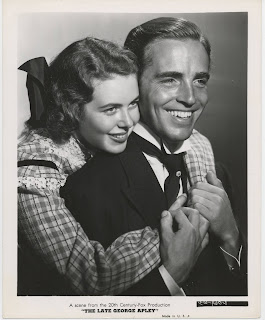
Favourite movies: The Late George Apley (1947)


John P. Marquand's popular Pulitzer prize-winning 1937 novel The Late George Apley skewered the pretentious upper-class Bostonian of the early 20th century. The deceased fictional title character is given the biographical treatment by one of his Boston Brahmin peers and through that narrow lens and the recollection of family and friends a portrait of George Apley emerges.

There is indeed much to snicker at in George Apley's exclusive existence, but as outside observers, we see much that escapes the notice of even his nearest and dearest. While the absurdity of the snobbery is rightfully put in its place, the reader also learns something about the heart of George Apley and his foibles. George Apley may be a fool, but perhaps no more so a fool than any of us.

Marquand and George S. Kaufman adapted the novel for Broadway where it had a successful run in the 1944-45 season starring Leo G. Carroll as George Apley. Since George Apley is no longer "late" as in passed on, we are left to wonder if "late" refers to the passing on of the old George Apley as he strives to adapt to the modern world of 1912 or maybe the fact that George is a late bloomer. Messrs. Marquand and Kaufman did not confide in me.


George Apley and his beloved Emerson
Ronald Colman

The 1947 Twentieth Century Fox film version was adapted by Philip Dunne (How Green Was My Valley) and directed by Joseph Mankiewicz (House of Strangers). Ronald Colman stars as George Apley in this movie released the same year as his Oscar-winning performance as the tormented actor Anthony John in A Double Life. George Apley's torments may be less harrowing than those of Anthony John's, but Colman's performance commitment is one hundred percent for both. As George Apley, he is initially the picture of upright, pompous certainty whose dawning bewilderment at events and people of differing ideas. George's enthusiastic attempts to set himself and all aright are a delight to behold.

George Apley has a place and standards to maintain. In his world, there is no excuse for shirt sleeves, no room in the cemetery plot for claim jumping distant relatives and no place for foreigners from Worcester. There is plenty of room for various clubs and committees. After all, someone must look after the orphaned waifs of Boston. To George's credit, an electric sign on the edge of the Common proclaiming "Grapenuts" would not add to the quality of anyone's life, but he seems almost anti-electricity. George's great love, beyond quoting Emerson, is bird watching. Of course, there is a committee for that as well.

Ronald Colman, Edna Best

Edna Best (The Man Who Knew Too Much) is charming and patient as George's wife Catherine, much softened from her novel incarnation. The Apleys have a headstrong daughter Ellie played by the vivacious Peggy Cummins (Gun Crazy). Her romantic involvement with a forward-thinking young professor played by Charles Russell (The Purple Heart) is a source of friction for the family. Richard Ney (Mrs. Miniver) is John Apley, so much like his father that it often makes his mother cry.

Ronald Colman, Richard Haydn

A large part of the plot of the play is based on the idea from the novel that George Apley truly likes his daughter-in-law. In the book, she is a divorcee from New York City. In the play and film, she is a young cousin determined to live life on her own terms, and that includes her marriage to son and heir John Apley.
Vanessa Brown, Richard Ney

Vanessa Brown, five years away from becoming the toast of Broadway as The Girl in The Seven Year Itch, plays cousin Agnes Willing. Agnes' parents are Nydia Westman (The Chocolate Soldier) as Jane and Richard Hadyn (Sitting Pretty) as Horatio. Horatio is a rather Iago-like character (shades of A Double Life) who supports all that is pretentious in George's lifestyle. He is overprotective of the class to which he has aligned himself.

Percy Waram

If any of the ensemble come close to stealing the show it is the only import from the original Broadway run, Percy Waram (Ministry of Fear) as George's brother-in-law Roger Newcombe. Roger is the voice of wet wisdom (he likes to drink) and dry wit as the anti-Horatio. He is married to George's formidable "should have been born the boy" sister Amelia played like a battleship in full sail by Mildred Natwick (The Quiet Man).

Times are changing and dear Roger tries to open George's eyes to that fact while Horatio keeps dragging George back to the status quo. Life, in all its untidiness, is thrust upon George Apley when he disastrously intervenes in his daughter's romance. George's admonishment to Ellie that emotions must be kept down has forever coloured the way I will watch Star Trek. For me, Vulcan is no longer a planet of enlightened beings, but a planet inhabited by stuffed shirts.

It is a joy to watch Ronald Colman as George Apley stumble and blink at the sunlight as he rushes headlong into an unfettered future. The comedy of his situation is told with knowing wit and a warm heart. One minute you want to hug him for his ardent effort and the next you'll want to slap him for a silly ass. You'll laugh at George Apley and you'll laugh with him. You will never forget him.


Sunday, September 1, 2013

Caftan Woman's Choice: One for September on TCM


Odds Against Tomorrow was one of two films produced in 1959 by HarBel Productions, the other being the post-apocalyptic drama The World, the Flesh and the Devil. Producer/actor/singer/activist Harry Belafonte stars in both highly personal projects. Co-produced with the film's director Robert Wise, Odds Against Tomorrow is a black and white caper story with a message filmed on location in New York. The script is by the black-listed Abraham Polonsky from a novel by William McGivern. Depending on where you place yourself on the film-noir front, it can be considered either the end of the post-war noir cycle or the beginning of a new cycle. 

Ed Begley (12 Angry Men, Sweet Bird of Youth) plays Dave Burke, a disgraced ex-cop with mob ties and a plan. He wants to make a lot of money, make it quick and get out. There's a bank in upstate New York ripe for the picking, but he needs two men with him for the job. He doesn't want pros.  He wants desperate men looking for that one big take. Men he can control. Dave thinks he has the perfect set-up.

The movie opens on an almost deserted NYC street in the autumn. In what I consider one of the best character introductions in noir, a lone man walks down the sidewalk, a grim and careworn Earle Slater played by Robert Ryan (The Set-Up, On Dangerous Ground). The street is not deserted as a group of children run in circles imitating the flock of geese above. A little girl stumbles and Earle bends and picks her up with a smile on his face and says "You're gonna break your neck trying to fly like that, you little pickaninny. Yes, you are."

Like a kick in the gut, the sense of unease begins and never lets up. Earle is a loser. He's a two-time loser from the penal system. His last stretch was for manslaughter. He's just past his prime and sees no way out of a life sustained by the hard work of his too devoted wife Lorry played by Shelley Winters (A Patch of Blue, Night of the Hunter). Slater is a man "...not made for waiting and I've been waiting all my life". Slater is a man who hates himself and turns that hate outward. He is an active and unrepentant bigot.

Robert Ryan was reluctant to take on the role of Earle Slater fearing comparisons to the anti-Semite Montgomery he portrayed in 1947s Crossfire and for which he received his only Academy Award nomination. In a 1959 interview in Ebony magazine, Ryan stated he thought it would be "a dangerous step for me to take professionally...audiences are composed of people with varying degrees of sophistication and understanding and there are many who do not separate actors from the characters they portray." Ryan relented after reading the script which he thought "says something of real significance and says it well, dramatically, without preaching."

Johnny Ingram is played by Harry Belafonte (Island in the Sun, Uptown Saturday Night). Outwardly, Johnny is everything Slater is not. Johnny is handsome and pulled together. A nightclub musician, Johnny dresses in the best and drives a flashy car. The ladies love him. He exudes confidence and goodwill. Johnny is also a hopeless gambler who is deeply in debt to gangster Bacco played by Will Kuluva (Crime in the Streets). Burke will use Bacco to convince Johnny to take part in the heist. Dave needs someone of Johnny's skin type for the job. On another level, Dave seems to have convinced himself that his actions are benevolent as he likes Johnny and Johnny really needs the money.

Johnny has one thing that means the world to him, his ex-wife Ruth played by Kim Hamilton (To Kill a Mockingbird) and daughter Edie played by young Lois Thorne. Johnny obviously adores Ruth and Edie, so why is the family broken? Johnny's gambling addiction is one reason. Ruth does not want financial instability to be a part of Edie's life. Johnny and Ruth are also world's apart emotionally. Johnny is a man who is bowed down by fate and the deck that is stacked and will always be against him. He berates Ruth that it doesn't matter how much tea she drinks with her ofay friends, the world is not going to be any better for Edie and it's time she wised up. Johnny is unwilling to consider softening his conviction even if it stands in the way of the family life he craves.

A couple of incidents convince Earle Slater to participate in the plan. One is when his self-loathing is exacerbated by cheating on Lorry with upstairs neighbour Helen played by Gloria Grahame (In a Lonely Place, It's a Wonderful Life). Johnny agrees to join the plan when Bacco threatens his family, but he senses doom, telling Dave  "It's suicide, man.  It's three o'clock in the morning."

Too late Dave Burke discovers that the two seemingly perfect men for the job have issues that he can't control and that threaten his plan. T'was ever thus in the caper film world. Slater is an instigator while Johnny stands his ground. The desperation and hate boil over to an explosive finish that will have a touch of familiarity for gangster film fans.


The score to Odds Against Tomorrow is by John Lewis and while jazz and film are not strangers, it is always a treat. The score, particularly Skating in Central Park remained an honoured part of the Modern Jazz Quartet repertoire for years. Legendary singer Mae Barnes is a joy trying to give the audience All Men Are Evil all the while being bedeviled by a drunk and sorrowful Johnny.

There is an interesting mix of familiar faces to watch for in Odds Against Tomorrow including Cicely Tyson, Zohra Lambert, Diana Sands, Mel Stewart, Wayne Rogers, Bill Zuckert, and Robert Earl Jones.

How well the film combines all its aspects will be up to the individual viewer. The Golden Globes nominated Odds Against Tomorrow in 1960 for its long-defunct category Best Film Promoting International Understanding.

TCM is screening Odds Against Tomorrow on Tuesday, September 10 at 6:00 am. It is well worth your time.


PERRY MASON: THE CASE OF THE SAUSALITO SUNRISE

Terence Towles Canote at A Shroud of Thoughts is hosting The 8th Annual Favourite TV Show Episode Blogathon . The popular blogathon is runn...